
“Let me break myself apart / instead and scatter to my birds”
Why the new single from Brandi Carlile is what we need to hear

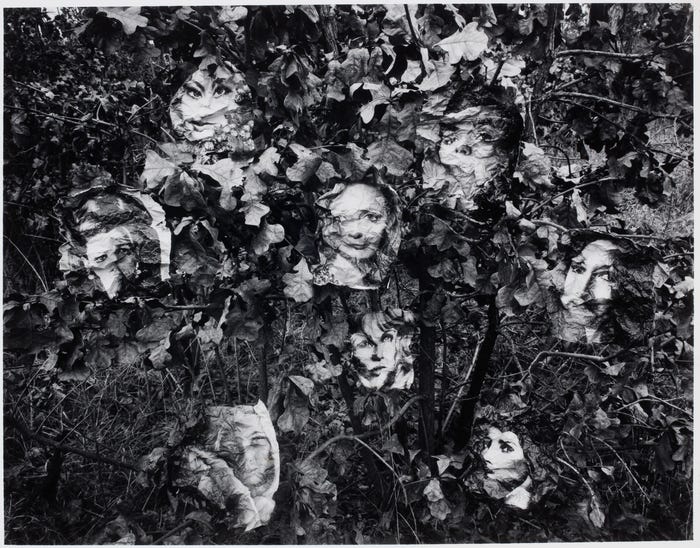
Photo credit: “Faces in Trees,” Murray Riss
Today, in standstill traffic, the dim gray morning light and colder air just outside my car window, I listened to Brandi Carlile’s new single, “Returning to Myself,” over, and over, and over again for all the reasons you might assume. I missed her voice in my speakers — I’m always going to listen when she sings (if only because of the tenderness, the heart that comes through) — and the deep gray of the cover art reflects that cloudy sky. I really kept listening, though, because the lyrics are mystifying and poignant enough to earn multiple hearings. I won’t try and guide your ear too much, but once you’ve listened and possibly come to the same conclusion I have (that these words deserve some extra attention), I’m offering my reflections and interpretation here.
Is there some freewheeling watcher
Shooting marbles in the sky
Holding your years between their fingers
Watching it burn till the fire dies?
Carlile opens with a huge question, one that she doesn’t try to answer but that does introduce the concept of individuality. Before we hear these words, we see the title, “Returning to Myself” — for me, this foregrounds what we might call an ‘inner child,’ a beyond-ego ‘true self.’ But she sings first of something beyond the self — the potential of a “freewheeling watcher” who does not take life and cut strings like the Greek Fates, but patiently watches it extinguish.
Why is it heroic to untether?
How is alone some holy grail?
And if we really come and go unknown
Couldn't I find myself in jail?
If it’s true that the watcher stands alone, if it’s true that we begin and end with ourselves, why is it so? Why is our version of the hero someone who does it alone? Why do we love the individual quest? Carlile is asking herself, if I retreat into myself, isn’t that unnatural? If I’m really alone here, have I jailed myself? From here, Carlile begins to lay out, in my opinion, the reinvention and multiplicity of self. She moves on from this self-made jail to address the keeper of it:
Oh, keeper how I love you
I love you and you and you
And returning to myself is such a lonely thing to do
But it's the only thing to do
This chorus, every time it happens, brings a radical shift towards the love of a “you,” also a shift in first person to a second person. But, is this really a second person? I was tempted to think so, given the relisting of “…you and you and you.” But the song, as restated in the line after, is about “returning to myself,” so how could there be so many other subjects here to love? What Carlile is embracing by repeating the “you” are the several corners and identities in herself. Yes, even the jailer/keeper is given love. It’s “the only thing to do,” a denial of self-hatred in any form.
Is it evolving turning inward?
Oh, what an easy way to be
Only kneeling at the altar of
The great and mighty me
Let me break myself apart
Instead and scatter to my birds
Like a burial at sea
To be the gospel without words
As much as the first verse and chorus asked for the love of self, this verse seems to deny self, calling out the “great and mighty me” in an ironic turn of phrase. Carlile is not arguing here whether or not we should turn inward, but perhaps how we go about it. In other words, self-idolizing can’t lead you to yourself (at least, not the true self). Instead, Carlile turns inward to break and scatter herself. Even this act is self-nourishment, though — she doesn’t feed the birds but “my birds.” The gospel without words, in my interpretation, is a breaking apart of the false self, a dying to yourself in a way that is clearly inspired by the teaching of Christ. (See Matthew 16: 25, “For whoever wants to save their life will lose it, but whoever loses their life for me will find it.”)
Oh, my darlings how I love you
I love you and you and you
And returning to myself is such a lonely thing to do
But it's the only thing to do
“My darlings” is, to me, directed towards the birds of self that are nourished by and pick apart the false self. We see a similar gesture to the first chorus, in which Carlile is offering love indiscriminately, to her jailer and now her birds — the community of self that disconnects solitude from isolation. The speaker, Brandi, is working through this alone but she contains multitudes. Perhaps, so do we.
There's no honor in the pilgrimage
Until a soul returns
To hold another's hand and then
And only then it learns
That life is like a stone
Only skipping for a time
Oh, it never really holds its own
It'll never see the other side
The song returns to the universe as Carlile questions again what the purpose of self-discovery could be. Try as we may, we can never be immortal, we can never truly “hold [our] own,” there must be a hand to hold. This motion is what complicates the song about isolation. Carlile knows that she’s held up by community, and the loving destruction of self ultimately serves to connect her (us) to other people. And, perhaps, this is what makes the song so unique: it refuses to deny others, and it refuses to deny self. It welcomes both — an acceptance that the care for the multitudes of self is not dissimilar from the care of the multitudes of souls outside your own.
And I was born to love you
I love you and you and you
Oh, returning to myself is such a lonely thing to do
Returning to myself is just returning me to you
And that's the only thing I want to do
I believe that Carlile is not closing on one definition of you. She means herself, she means ‘the world,’ she overflows with “you”s. In fact, the phrase “returning me to you” subverts the expectation of what returning to yourself actually means. It doesn’t have to be such a lonely thing to do when every instance of “me” becomes an instance of “you.” Carlile has turned, and re-turned, the self (me) to the cosmos (you).
Do you agree with me? Disagree? Either way, the song has offered for me today a feeling of wonderful un-anchoring in a world that seems to constantly ask us to be more interested in self-preservation than breaking ourselves apart. Somehow, it’s a radical ask to find personal identity in communal solidarity, to return ourselves to each other. I needed it, and I hope it benefits you to hear as well.